

Explainer: Why a Strong, Healthy Middle Class Matters
Healthy people make a healthy economy
We talk a lot about billionaires. We talk about poverty. But the middle class—long a source of stability and shared opportunity in America—has been shrinking for decades. That shift affects everything: our economy, our democracy, and our daily lives.
A strong, healthy middle class keeps the country steady. When people are healthy and secure, the system works.
---
A healthy middle class makes everything else possible
This isn’t just about jobs. A strong middle class means people are able to live with dignity—secure housing, affordable healthcare, time for family, and a sense of fairness in the system. Healthy people make a healthy economy.
This is not a zero-sum game: when the middle thrives, the entire country benefits.
---
1. It powers the economy
Consumer spending makes up about 70% of U.S. Gross Domestic Product (GDP), and the middle class drives most of that. When people have enough to meet their needs—and spend a little more—they fuel demand. That demand keeps businesses open, jobs steady, and wages rising.
The middle class also provides much of the skilled labor, and a significant share of small business ownership—the backbone of many local economies. When the middle grows, the economy tends to grow with it.
---
2. It funds public services
Middle-income households contribute a large share of federal revenue through income and payroll taxes. Those taxes fund the services we all rely on—schools, healthcare, infrastructure, emergency response, and more. And in turn, these services strengthen the health of the country in a feedback loop.
When the middle class is strong, those services are stronger too. When it’s under pressure, so are they.
---
3. It makes opportunity real
Opportunity isn’t a slogan—it’s the ability to picture something better and actually have a shot at it. But when you’re poor, even survival is a struggle. You might not have child care, a car, work clothes, or the health to keep a steady job. It’s not just hard to get ahead—it’s hard to survive.
When people are pushed that far to the margins, they can’t contribute much to the economy, and they often become treated as a cost instead of a resource.
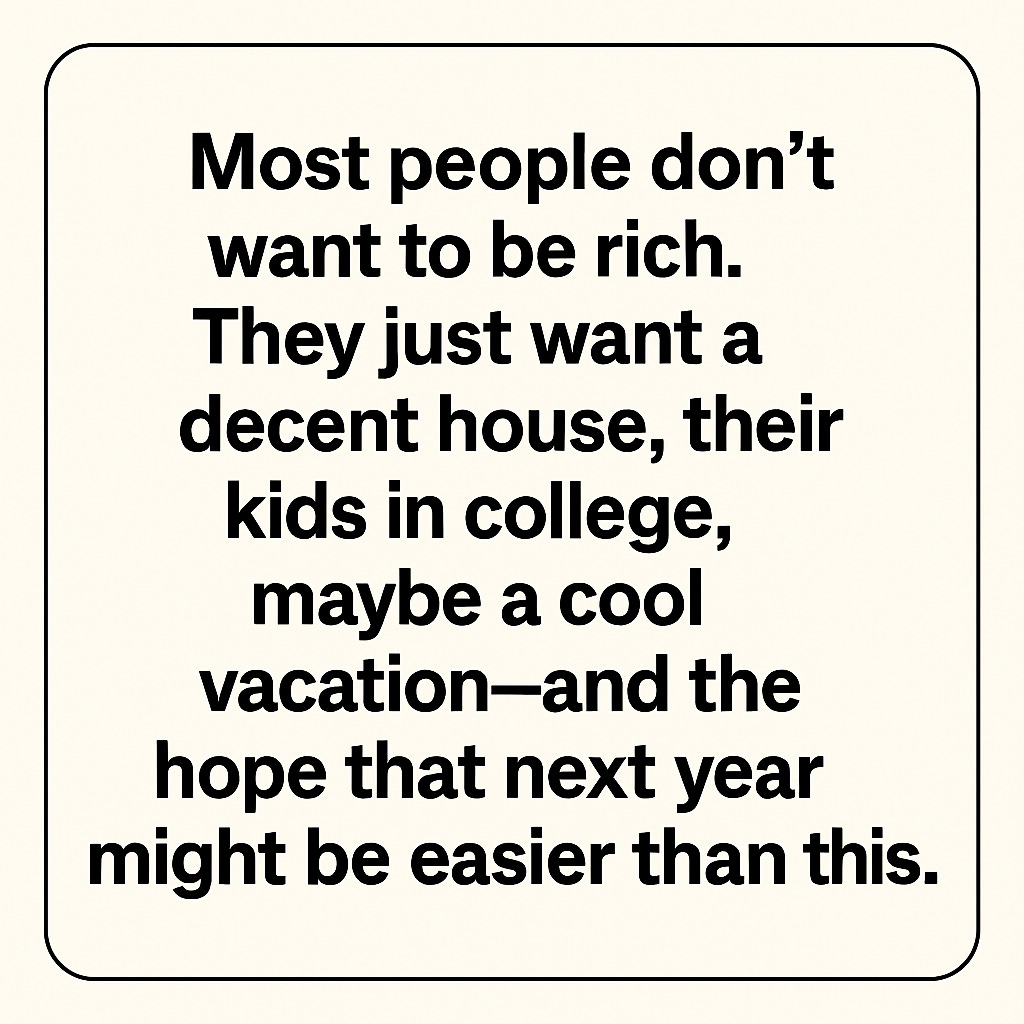
Most people don’t want to be rich. But they’d like a decent house. Maybe a cool vacation. They want their kids in college, and to feel like next year might be easier than this one. A strong middle class is built on hope. When people believe they can move up, they stay invested in the future.
---
4. It holds society together
The wider the gap between the wealthy and everyone else, the less stable society becomes. People who feel shut out lose trust—in the system, in each other, in the future.
A strong middle class helps close that gap. It reduces tension, resentment, and polarization. It creates a shared sense of participation and investment that makes division less intense and unity more possible.
---
5. It strengthens democracy
People who feel economically secure are more likely to vote, speak up, and engage. They have the bandwidth to pay attention and the belief that their voice matters.
A healthy middle class also helps counterbalance extreme wealth and concentrated political power. It’s harder for democracy to function when the needs of the many are drowned out by the influence of the few.
---
6. It creates economic stability
Middle-class spending is broad and steady. It flows across regions, industries, and income levels, creating a ripple effect—what economists call a multiplier. One person’s spending becomes someone else’s income, which becomes another person’s job.
That steady circulation helps prevent the economy from swinging too wildly. In contrast, when wealth is concentrated at the top, spending becomes more erratic, and savings are often hoarded or invested in ways that don’t generate jobs. A strong middle class spreads both risk and reward more evenly, creating a more stable and resilient economy.
---
7. We built it once
The strongest middle class in U.S. history emerged after World War II. That didn’t happen by chance. It came from specific choices:
Public investment in education, housing, and infrastructure
Strong labor protections and unions that helped raise wages and improve working conditions
Programs like Social Security and the GI Bill that expanded access to opportunity
A progressive tax structure that helped moderate income inequality
That last point is often misunderstood. In the 1950s and '60s, top marginal tax rates were very high—but that didn’t mean wealthy people paid 90% of their income. What it did was even out the total share of income paid in taxes across income levels. Today, the wealthiest often shift their income into forms that get taxed less—like capital gains or corporate entities. A fair tax system doesn’t punish success—it makes sure those with the most privilege contribute a balanced share.
---
8. We can do it again
Over the past few decades, we’ve allowed the pillars of the middle class to erode. Wages stagnated. Housing and education became unaffordable. Healthcare became a financial threat instead of a public good. And the tax code tilted further toward the already wealthy.
We can change direction. That starts with:
Education: Invest in public schools and higher education so students aren’t crushed by debt before they even enter the workforce.
Infrastructure and housing: Expand access to affordable housing and upgrade the systems that make everyday life possible—transportation, energy, water, and internet.
Healthcare: The U.S. spends more per person on healthcare than any other developed nation—and still has worse health outcomes. That’s because too much of our healthcare spending goes to profit, not care. Insurance companies siphon funds out of the system to generate returns for investors. A healthy middle class needs a healthcare system designed for public health, not corporate gain.
Wages and worker protections: Strengthen labor laws, raise the minimum wage, and support collective bargaining.
Fair taxation: Make sure those who’ve benefited most from the system contribute a balanced share to keep it strong.
We know this works. We’ve done it before.
---
The bottom line
A strong, healthy middle class creates a strong country. It powers the economy, stabilizes democracy, and holds society together.
To build a future that works, we will respect and rebuild the middle.
FURTHER READING
You may be interested in our companion article, America's Middle Class Will Save It
Pew Research Center – How the American middle class has changed in the past five decades
https://www.pewresearch.org/short-reads/2022/04/20/how-the-american-middle-class-has-changed-in-the-past-five-decades/
OECD – United States: Challenges faced by the middle class
https://oecdecoscope.blog/2022/10/12/united-states-challenges-faced-by-the-middle-class/
Insight @ Kellogg – Is Social Mobility Important to Democracy?
https://insight.kellogg.northwestern.edu/article/is-social-mobility-important-to-democracy
CSSNY – National Poll: Economic Hardships Facing the American Middle Class
https://www.cssny.org/news/entry/national-poll-economic-hardships-american-middle-class-true-cost-of-living-press-release
MarketWatch – Middle- and Low-Income Americans Say They’re Sacrificing Happiness
https://www.marketwatch.com/story/low-and-middle-income-americans-say-they-are-sacrificing-their-happiness-in-the-face-of-stubborn-inflation-and-more-tariffs-ahead-3bba0518
Democracy Journal – Growth and the Middle Class
https://democracyjournal.org/magazine/20/growth-and-the-middle-class/